Friday, 7 October 2011

Pillars and pastries

Finally, a bit of sightseeing. Almost a week ago now - I blame homework, True Blood and a third bout of Arab dysentery for this appaling lateness - we finally woke up in time for some cultural activity. As I write this the friday morning sermon is drawing to a close, the booming voices of the mosques again melting into one. We've moved the 'Happy Rabbit Babies' bedclothes out onto the balcony and the sun is shining again after some near-English weather in the last few days.

The Catacombs in Alexandria, or Kom al Shu'afa, are located some distance away from our apartment in a somewhat run-down but extremely busy area of town. There are numerous entrances but one main spiral staircase leads down to the majority of accessible chambers, a labyrinth of dusty passageways and alcoves where the dead - presumably those of an elevated social/economic status, though it is not explained - were laid to rest below ground in stone sarcophagi. Photos are not permitted, and the few I take through bribery and sheer cheek are not really worth showing, but essentially we're looking at the early levels of Tomb Raider 4, complete with a guide almost as ancient as the place itself and a silence that after so long in the city is eerie and unexpected. Some rooms are high-ceilinged and airy, with shafts of light falling in white squares from the modern skylights; others are tiny and oppresive and can only be reached by intrepid short people. Good training for the pyramids perhaps.

While the majority of the catacombs are bare granite, some walls are still adorned with the original faded paintings and carvings of Egyptian gods - and, further on in the larger tombs, fragments of Roman mosaics. In one room a spectacular depiction of the mummification process while Anubis looks on is emblazoned on the wall above a huge stone burial niche. Elsewhere there is the 'banquet room' where the families of the deceased could gather for meals in the company of their loved ones.

The Catacombs were only discovered in the 1800s when, according to the guidebooks and a sign near the entrance to one of the tombs, a donkey literally fell through a weak section of pavement and opened up the hidden world beneath. In a room near the back of the available tombs, assembled in a glass case, is the skeleton of an animal without explanation. Although Egyptians were often buried with their pets and holy animals were occasionally mummified, we wonder if it might be the ill-fated but legendary beast of burden that led to this vast, accidental discovery.

It doesn't take long to look around and we move on to 'Pompey's Pillar', one of the best-known monuments still standing in Alexandria. It's a short walk away from the Catacombs through an area so stereotypically Arabic that the only thing my poor Western brain can compare it to is the fictional town in Team America. See below (some of my favourite pictures from our time here so far, apart from the rubbish dump):


Above: yet another bumper sticker captures the mood.
Below: happy faces following dirt-cheap date biscuits from a street vendor.


The pillar overlooks part of the ancient acropolis and was erected between 200 and 300AD, originally as part of a temple colonnade. Remnants of the old city surround it, including statues, the foundations of old buildings and a series of underground tunnels believed to have once housed the books that could not fit into the library. Two immense Sphinxes sit in front of the pillar, gazing out at the modern landscape.


That's all for now; more beachy goodness in days to come.

Saturday, 1 October 2011

Demonstrations - 30/09/2011


In this post are my photos from the demonstrations in Alexandria on Friday the 30th of September; protests took place in the two main cities, with thousands taking to the streets to express frustration with the actions of the temporary military government, among them the highly controversial set of laws allowed during a 'state of emergency' most believe does not exist, and severe limitations to the electoral system.There was talk of reviving the spirit of January the 25th, and of placing the revolution back in the hands of the Egyptian people. Ahram Online called it 'The Friday of Reclaiming the Revolution.'


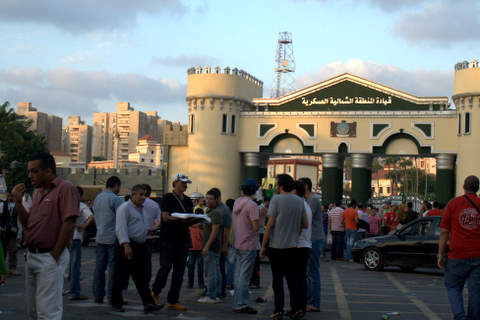
Above: crowds gather opposite the military base in Sidi Gaber district, Alexandria, at around two o'clock. Most have come from two earlier demonstrations at the Al-Qaed Ibrahim Mosque, and Maharam Bek, not far from our apartment. As we arrive a group begins to form at the top of the street. Yet another reason why we are exceptionally lucky to have the friends we do in town; Y agrees to accompany me today where it would have been impossible for me to go otherwise. All obvious dangers aside, Egyptians are a little suspicious of anyone wielding a camera at such gatherings because previous photos have been used to track protesters. We are stopped periodically by people asking "Sahafa?" - "Journalist?", just in case.

Below: people from across Alexandria make their way down the street. The majority of chants are to do with emergency law but we catch "Expensive sugar, expensive oil" - a reference to the US and its perceived over-involvement and excessive influence in the run-up to the elections.


At this point, interestingly, Y points out that despite the numbers present today a lot of Egyptians disagree with, or are at least display far less enthusiasm for, the protests that take place on more or less a weekly basis in Cairo and Alexandria (though obviously today was bigger) - the reason being, he believes, that it brings businesses, transport and effectively the economy they support to a standstill for at least a day and usually more at a time when things are perhaps especially delicate. Furthermore he believes along with many others that the people have done what they set out to do for the country; the current conditions are undesirable, but essentially a short-term crease to be inevitably smoothed out over time.

He may well be right - but I wonder if, in a country apparently lacking in a continuous system of checks and balances and with national media apparently under threat, these brief though inconvenient expressions of public anguish are crucial to keeping those in authority - whoever they may be - under constant scrutiny. While I have no doubt that those protesting today are doing so out of a sincere desire for change, even if the amendments they demand were impossible it would make their assertions no less important at a time when the power may easily fall into the hands of the 'undeserving few'.


Back at the top of the street, crowds continue to demonstrate in front of the army base. One of the first things we were told before coming to Egypt - by teachers, travel guides and the Foreign Office itself - was to under no circumstances photograph anything related to the military. However. One of the many curious onlookers is a journalist who works for two major Egyptian news agencies and seems pleased to see a British - or perhaps a British-camera-hefting-Arabic-speaking - face. With his identification card he can photograph whatever he wants, and by extension for and for as long as we stay with him, so can I. Hence:


From what we saw which was admittedly several hours after the marches first began, on the whole the day's events were peaceful and - albeit with a hugely appreciated Egyptian escort, or two - quite safe. Of course Cairo was a different story; with greater numbers come starker variations in opinion, and higher-running tensions to say the very least. But in Alexandria, where protests were in part organised by the Youth for Freedom and Justice Movement and the Revolutionary Youth Coalition, the overwhelming feeling was one of unity, and assertion, without aggression.


In praise of juice

Just to clarify, I currently have two upcoming posts - one on what's taken place in the last few days, and one regarding the protests in Alexandria yesterday. Of course these could be mashed into one but I don't feel it would do the latter justice.

So - on Thursday night, following waves of panic regarding what the hell to wear and whether or not to eat dinner (first-world problems putting us in the right midset for the evening) we head to the British Consulate office, which is located in a somewhat richer and prettier area of town - a quiet, whitewashed oasis surrounded by sprawling, narrow streets where washing lines criss-cross overhead and cats dodge between unmoving cars. We cross an empty square and hand our invitations (and cameras) over before going inside.

The reception is in the back garden, with a few guests already milling around and fairy lights wound around the trees. When we go hunting for the toilet we discover the inside of the building looks and noticeably smells like a sixth-form college - apart from the posters on what to do on discovering explosives. Aside from a five-minute speech detailing a few of the upcoming events in the city we are left to our own devices, and get to know a few students from SOAS and Durham who are studying at the main university. Some have bought wedding rings and planned stories so as to live in mixed groups during their time here, though most are only staying for three months due to studying Arabic, Russian and Chinese. I feel a little inadequate and in true Leeds style (and along with the rest of our contingent I might add), hit the free bar.

Drinking in a Middle Eastern country feels very, very weird. Despite having been assured by a new friend - will call him Y because of the upcoming post - that a lot of Egyptian Muslims do drink, and despite the gin being Gordon's and the tonic Schweppes and the first branded alcohol we've seen so far, minds and stomachs alike are quick to communicate that there's something wrong. I blame a combination of near-constant dehydration and an almost entirely dry September for a number of us feeling quite sick - and more to the point, it doesn't mix well with shisha.

Following the two hours at the consulate we make our way to the confusingly-named 'Portuguese bar', where a woman (originally from Leeds!) explains in a jovial but businesslike manner that this is a 'haven for expats' we'll probably end up frequenting. I remain unconvinced; between the sheets of drink tokens reminiscent of a grimy all-inclusive holiday, the club anthems we tried so hard to escape from at Leeds blasting in the empty 'disco room' upstairs and the fact that we receive more eyeball-undressing from the beer-soaked bald men playing pool here than we have in a month in Alexandria, I think I'd rather stay honorary Arab for the year. Sorry.

Our feelings as a flat are cemented the following evening when we go out with Riham and her friends, this time to a restaurant on the very outskirts of Alexandria, bordering on the desert itself. The drive is around half an hour and takes you past the industrial zone of ACL and Merghem, into an endless flat land surrounded by still, silent marshes. Rows of expansive and identical villas border the main road, complete with gardens and swimming pools and blissfully free of rubbish.


We spend an hour or so in a very quiet restaurant by the side of the road, sat on moth-eaten mats and eating with our hands Egyptian-style; the shisha here is thick and the tea served in thimble-sized glasses, like expresso shots. We then move to a cafe on an 'island' of wooden boards where we drink mango juice and have our fusha Arabic ridiculed - again. It transpires that fusha is the equivalent of Shakespearean English and is used only in newspapers and some official documents; ironically Egyptian Arabic is far easier but for the sake of not getting confused, I've elected to learn the bare minimum this year and get by talking like I'm in a time warp. On this topic, we also discovered that the first week we were here we consistently got Riham's name wrong, calling her Rahim, which means uterus.

On the way back Hossam's friend, who spent a long time in Kuwait, laments the lack of organisation in Egyptian driving - the white lines on the road, he says, were a waste of paint as most people aren't aware they hold any function apart from decoration. He likens both driving and crossing to playing a video game; for pedestrians, as we have also discovered, it's a matter of shutting down, ceasing to think and moving by instinct alone between safe zones lest you lose a life. For the drivers it's more like Grand Theft Aut. Need I say more. He also mentions the huge goth and metalhead community in Alexandria, who regularly gather at the library for gigs. I've already noticed the first Evanescence album playing in more than one ordinary restaurant alongside Amr Diab and am pretty sure curiosity will get the better of me at some point.


Overall we have a cool and animated but shattering evening in true British-abroad style, followed a genuinely lovely one with our Arab friends. I'm sure the time will come when all we want to do is flick soggy pub mats across a table at one another through a cigarette fug with football blaring in the background... but it's not yet. Nowhere near.

Tuesday, 27 September 2011

Culchuh injecshun

A few days into our studies at ACL, and any surviving notions of this being a year's holiday have been more or less stripped away. Long afternoons spent people-watching in cafes or channel-hopping have been replaced with homework sessions and the frantic production of pointless flashcards, or else have taken on an air of guilt that certainly wasn't there before - you know, when we were meant to be revising all summer. I scored fifty-two out of a hundred in our placement test and was at the higher end of the scale. Clearly we have a long way to go.

Our study of the Arabic language is divided into four unofficial modules - grammar, speaking, Egyptian colloquial ('aamaya) and 'everything else'. The teachers are all exceptional, and classes are about a quarter of the size they were last year, which is a huge help. For our grammar studies we have Gad, who bears a striking resemblance to the Rain Man and fiddles with his pens in a similar manner, but conveys in slow, methodical English a great enthusiasm for what is probably the least exciting aspect of the language - in explaining the verb forms he is "giving us the key" and "building the foundations... and you can now go as high... as you like." Cue big smile. All four are from Alexandria though one, Muhammad Ansary, has studied English literature and travelled extensively, and has given us Arabic nicknames for the year (the point being that the year abroad isn't about studying a language but cultural immersion, a term that would make me shudder had anyone else said it but in this instance we found ourselves nodding along). Mine remains Hannah though - as many grinning supermarket workers have been keen to point out, Ù‡Ù†Ø§ is an Arabic name.

Homework assignments, as with all languages, look more time-consuming and blood-pressure-raising than they turn out to be, for the simple reason that you either know the answer or you don't. More often that not so far it's the latter.

On a more interesting note - today we took a brief detour on the way home after filling up on 80p shawarma to visit the French Institute, about fifteen minutes from Wabuur al Maya. This is the first time we've been out at this point in the day, when schools empty and many people go home from work - even if only to nap for a few hours before pouring back into the streets at night. It's almost unbearably hot, jam-packed, raucous and unsanitary but full of life and colour. And, as we then discover, second-hand books. The place is a goldmine.


What Deko happily refers to as 'literary jewels' cram the shelves of a line of stalls down the middle of the road, shoulder-to-shoulder with children's magazines, travel guides, mechanic's handbooks and religious texts in English, Arabic and French. I pick up The Poisonwood Bible for two English pounds and she buys six volumes for eight and a promise that we will be coming back. Some are pictured below along with some baklava that we assume is another impossible bargain (£3.40 for one kilo) but turns out to taste of cow ghee and disappointment.


Stay tuned for next Thursday though, as in the last few days we have also received this:


Saturday, 24 September 2011

Peaches and fail

Termtime at the Institute has officially begun! The building works are now more or less finished and classes start tomorrow morning - and despite having an Arabic week with a day off on friday, it really is the morning. From our point of view perhaps the only benefit to staying at ACL is the feasability of staying in bed until nine (wild) while we on the other hand are learning the hard way to get used to a 7:30am start. The sound of the children over the road chanting their English alphabet is no longer an annoyance but an alarm clock. Rage.

Feedback from those staying at the Institute is for the most part positive, if a little bored. The only way to get into town is via a scheduled bus so many of the students there have yet to properly explore Alexandria. Still, there's a small gym now set up, television and regular pilgrimages to Carrefour - and who needs the seafront when you can dabble your toes in a marsh. Magda's grandchildren are often about for a game of basketball in the little front courtyard and a skinny, sleepy cat flops on unsuspecting laps. Judging by the Arabic shouting match that followed, in asking for a Nescafe I appear to have christened the coffee machine too.

This is the first year ACL have had their own accommodation and the rules are clear: amongst others, no hugs (between male and female pupils, even on site! - our greetings were tinged with slight exasperation), no drugs (apparently prevalent in Alexandria, where the pint glasses of sugar cane juice alone ought to be a Class A) and no political activism. This last point is backed up with a story about a student two years ago who wisely chose to spend his year abroad distributing leaflets for some fundamentalists he met at a mosque. No fear there. As a liberal lefty in Egypt at this time, or indeed any relatively well-informed young person, it's hard not to feel saturated in the 'spirit of the revolution' that smiles from the pages of magazines, stares from billboards, glistens on the graffiti-covered walls - but to engage in protest ourselves I feel would not only be irredeemably stupid but a little patronising towards the efforts of the people who were actually here in January, and have to continue to live here once we're gone. The message was clear: say what you want, write what you want, photograph what you want provided it's not in a uniform. But you are a tourist, and now especially it's only apropriate to behave as such.

Which brings me to what we did the following day. Knowing we had a 'placement exam' and Egyptian colloqual oral exam the next day, we did what any sensible student abroad would do: we went to the beach.

To clarify, this is not the Alexandria seafront, which is heaving during the day and too full of 'sharks' (the testosterone-fuelled kind; real sharks would be a picnic by comparison) to bear thinking about, but Montazer beach, a little further down and usually requiring membership to get inside. Enter Riham. The family we rented our apartment from also have a flat downtown, and, would you believe, a beach house. We meet them early on Friday morning and drive down, and are joined later by the rest of the class.
Above: Some of the fiendishly expensive seaside homes; the 'real' beach is about five minutes away.
Below: Sunbathing, and Jakub the highly compliant sandman. Below below: we return to the beach hut and prance about on the neighbouring roof where apparently it's possible to sleep at night.


The sea here is warm by midday and while there are a few rocks underfoot, it's highly swimmable. Alexandrian beaches are man-made so the sand is under a foot deep, which unfortunately means no digging holes. However we spend a lovely afternoon slow-cooking under the Egyptian sun, eating melted KitKats and having our fusha (Modern Standard Arabic) relentlessly mocked, again. On the way back listening to Buzzin and avoiding the old men on motorbikes making kissy noises - yes there are more than one - we spot the best bumper sticker so far. Oh Abdo.


Am having a hard time taking the idea of work seriously. As it turns out this attitude is really just as well, because the next day we sit our placement test, and even if we had spent the last week revising it would have been beyond nightmarish. As previously mentioned we have never learned the colours. Or gerunds. Or how to spell in any capacity. Falling asleep midway was probably avoidable but hopefully that will get easier in a few days' time, whereas our Arabic appears to be at least a year behind what they'd anticipated. We are to be divided into two ability-based groups, presumably Awful and Mostly Awful, and given alternate Arabic names for the year just to drive our incompetence home. For the first time in five months, tomorrow we open our Al-Kittabs. In the meantime I think the picture below sums up the general mood for the day:

Tuesday, 20 September 2011

Procrastination in pictures

Who would have thought it possible to suffer cabin fever in such a lovely cabin. After two days of vegging, True Blood and speculation we realise it's about time we 'did something' and so once the heat of the day has more or less passed (the best way of measuring this is not looking at a clock but standing on the pavement outside and observing whether or not anyone faints) we head out towards the library, and our favourite cafe.


Finally, after two weeks, we get our hands on some shisha. In Turkey early this summer a friend of mine, who lives in Istanbul, assured me Egyptian shisha was the best in the world - perhaps an urban myth but certainly, especially given that we paid just £1.50 for several hours' worth of cherry-flavoured coughing, I'm pleased to report that it is at the very least pretty damn good. Over chocolate milkshakes and date juice so sugary it leaves a silty texture in the mouth (Arabs apparently compensate for lack of alcohol with overloads of smoke and sweetness) we watch the sky darken and the waves roll in - and try to ignore the feeling of several (mostly) politely curious eyes on our every move.

Since being here, and aside from other Leeds students, I have counted a grand total of two other white/British people, one of them a rather put-upon looking ginger probably fed up of the staring. Vicky and I spent some of this summer in Jordan so we count the fact that nobody has cried "Shakira" or "Very very very very nnnaaaaaiiiiicceee" as a minor blessing, but certainly as a Westerner you cannot escape the feeling of being a spectacle. Most of the time we receive mere cursory glances, and even warm smiles from some of the women, but in the market lack of headscarf means you must endure a droning "WOOW. WOOW. WOOW" while struggling as it is with the stress of haggling.

Below: a few pictures taken as we trundle along the seafront. We have decided that over the year the sea air will counteract the worst effects of the nicotine-laced shisha, and hopefully also our near-chronic laziness.


As the night draws in, so too does the traffic. Deko's book on the Liquid Continent warns that Alexandrians drive 'like lunatics' but in reality it seems the pedestrians are the ones with a few screws loose. In a city where right of way is non-existent, there are no lanes, drivers alternately smoke and chat on the phone and swerving is apparently an art form meant to be practised at every opportunity, we are a little awestruck by the breezy manner in which locals meander through the vehicles, without even a pause for thought. When Natasha gets stuck a group of young Egyptians laugh and urge her on before applauding when we finally arrive in one peace, about ten minutes later. In the gridlocked roads the blaring of ambulance sirens is entirely redundant.


So far we have made our way around the city almost entirely by taxi - a ride from our area to the seafront costs little over £1, mostly because drivers are so exasperated with our level of spoken Arabic to argue. Journeys are frequently 'layered up' to save time on both sides (yesterday I went back to the flat alone until we picked up a woman trying to get to university). I try as far as possible not to mock when Arabs clearly don't understand the English slogans displayed on clothes, signs etc, but some of the bumper stickers here are hilarious - favourites so far have included 'No Friends Here' and 'GEAM (yes, GEAM) OVER'. However there is also a tram system in Alexandria dating back to the colonial period.

We stroll back from the Corniche and realise for the first time that the mainly quiet, friendly area where we are now living is in fact more or less directly opposite a huge Christian graveyard. Stretching for what seems to be a square kilometre, it's broken up according to various sects including Coptic Christians, protestants and Egyptian orthodox worshippers, clustered silently together under the ragged palms. We try to get a closer look through the iron gate but a group of enthusiastic guard-dogs materialise as if from nowhere, making us all jump.


We continue on and after another quick brush with death at the next main road, cross Shalalat gardens (below) and reach the Wabuur al Maya roundabout, below below (holy light purely coincidental):


That night - well, I say night, more like the following morning - Vicky and I are still awake at 4am, wired on peanut butter and discussing whether it would be better to remain celibate and unloved forever or marry Mr Bean when a noise creeps in that brings all conversation to a halt: the morning call to prayer. This is the first time I've heard it since arriving here and the sound is entirely different to all the others we've heard, a steady, slow echo less like words and more a low stirring groan across the city, drifting from one minaret to the next and falling like a blanket over the sounds of the street. We haven't yet worked out how many Egyptians follow the five-times-a-day prayer but in any case it is an eerie, beautiful noise that commands silence. A little like the beginning of Jim Henson's The Dark Crystal when all the Mystics start singing, but with fewer puppet strings and more majesty. At this rate I will run out of colourful vocabulary before we reach the pyramids but, unlike the pyramids, no photograph can express this experience. Even without being religious the feeling of smallness is profound, and we stay awake for a further half hour, though this might also have something to do with spider paranoia.

To conclude, and lighten the mood of this post (or not....), here is a mug we found in our cupboard. Hmmr.

Sunday, 18 September 2011

Box of Frogs

Just as I was considering attempting to construct some kind of post explaining the current political situation in Egypt, an article appeared on Al Jazeera with the first set of election dates. Literally three minutes ago. I've taken it as a sign.

Today a number of Egyptian political parties will meet to discuss arrangements for elections to the lower house of parliament, which should, all going well, take place on the 21st of November. The whole election process is being held in three stages and seems to be occurring a little later than originally intended; it was previously hoped that the presidential election itself would have taken place by the end of summer, or early autumn. Now it looks to be pushed back until at least December, most likely some time next year.

By the time a new regime is established, Egypt will have been under military rule (and thus without a concrete head of state) for quite some time; as previously mentioned it is surely testament to the integrity of the Egyptian people that the country continues to function as normal, with the bare minimum - as far as I can tell - of disruption to public services. As I write this a few local children appear to be pitching in to help clean up the rubbish dump outside. Whether this is down to the more or less nationwide presence of faith (around 90% of the population are identified as Muslim, and many more are Coptic Christians) or merely a sincere committal to the revolution is unclear. Either way it also serves to underline the pathetic, laughable nature of the recent UK riots and the 'motivation' behind them.

Nonetheless - at some stage, the fifth Egyptian president must be chosen. Surveys from earlier this year suggest that the favourite to win is Amr Moussa, former Foreign Minister and  the ex-Secretary General of the League of Arab States. Despite obvious links to Mubarak, his assertions regarding policies towards Gaza and the West Bank, criticisms of U.S foreign policy and many years of experience have made him an extremely popular figure; it has been speculated that Mubarak send him to work for the Arab League in 2001 to prevent him running in the 2005 elections himself.

The principle rival for leadership is Muhammad AlBaradei, previously head of the International Atomic Energy Agency and winner of the 2005 Nobel Peace Prize, a key figure during the protests and staunch supporter of free and fair elections in Egypt. His comparative lack of popularity may be due in no small part to his support for several policies that clash with current U.S. policy towards future stability in the Middle East. Other candidates include the ex-head of the International Union of Muslim Scholars and an ex-member of the Muslim Brotherhood popular with the youth, who was expelled for his decision to run.

More on the various candidates once I've had a chance to speak to people about their views, which will take some time. In the meantime it seems that in keeping with this new spirit of camaraderie and participation it is not just the temporary government and national media that are making sterling efforts to keep the population informed; a monthly magazine for Cilantro (a chain of cafes) explains in its 'Political Corner' how to vote in a parliamentary election and presents a guide to citizen journalism, while the 'Alex Agenda' (tagline: 'what's Up Alexandria') is sponsoring the Election System Stimulator, a series of lectures and workshops organised by a group of indipendent youth in the hopes of 'eliminat[ing] ignorance' and 'sharing a common vision of raising awareness and civil community engagement'.

However it would be naive to suggest that the transition will be smooth; the Supreme Council of the Armed Forces, which has ruled since Mubarak stepped down, announced following clashes at the Israeli embassy last week its intentions to broaden the application of 'emergency law' in Egypt, including the suspension of civilian rights and the temporary use of the special 'security courts' strongly associated with the Mubarak regime. According to the Guardian website,

"The new military decree extends emergency law to cover a glut of vaguely defined transgressions that could easily be applied to legitimate protest, including "infringing on others' right to work", "impeding the flow of traffic", and "spreading false information in the media"."

Some days ago the imposition of a block on national media was discussed furiously on Al Jazeera, one of a number of channels now believed to be under threat. An eloquent and justifiably exasperated journalist ridiculed the notion that Egypt was currently in a state of emergency, and even if it was, that the idea was unthinkable. The phrase 'blathering idiots' was used, amongst others.
The quote-heavy Amnesty International page offers a little more information on the actual restrictions imposed by the temporary governing body: http://www.amnesty.org.uk/news_details.asp?NewsID=19690

More on this as it develops. In the meantime, I'm going back to Cilantro.